AI Just Raised $24 Million to Understand Sound and Video: Yours Can Already Read
September 3, 2026 · AI & Automation
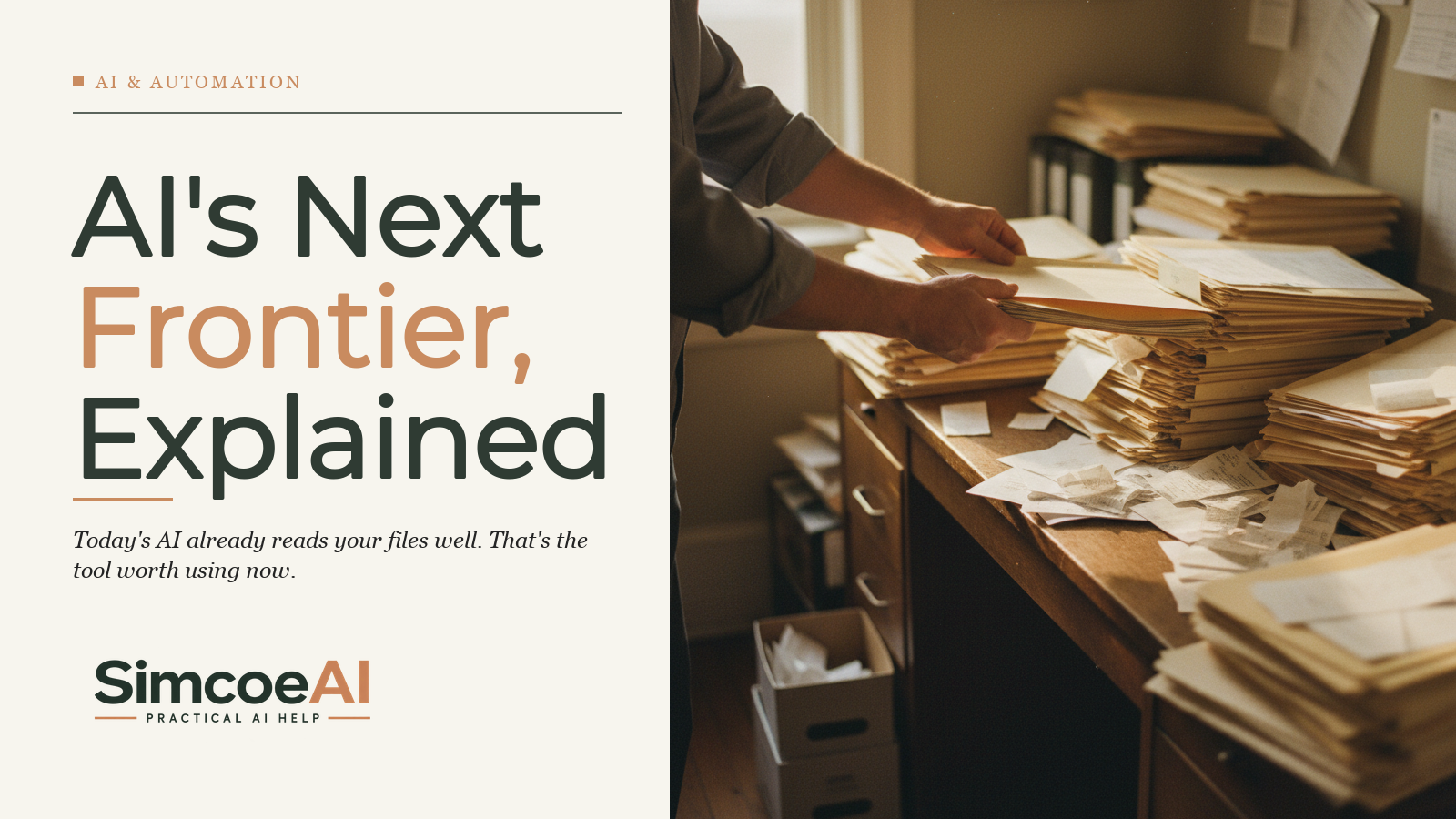
Image generated with AI.
If your business runs on a Google Drive nobody can search, a shared folder full of "final_v3" files, and a filing cabinet nobody has opened since spring, you don't need next-generation AI. You need this week's AI, pointed at the files you already have.
That gap between what AI can already do and what most small businesses actually use it for is worth naming today, because a fresh funding announcement just drew a clean line around it. On 2 September 2026, Vancouver-founded startup Mundo AI closed a $24 million USD round (a $20 million Series A led by GreatPoint Ventures, on top of a previously undisclosed $4 million seed) to build training data for AI systems that understand sound, video, and the physical world. The company calls this "the data layer for perceptual intelligence," and its own framing is blunt: today's AI reasons well over text, but it is still weak at everything that isn't text.
What this news actually means for you
Nothing changes in your business today because of this round. Mundo AI is building research infrastructure: datasets and evaluations other AI labs will train on, years before it shows up in a product you'd recognize. It has no Canadian government backing, no Simcoe or Ontario presence, and it isn't selling anything a local business would buy. That's not a knock on the company; it's just not this week's tool.
But the round is useful as a signpost. It confirms, from people raising serious money to fix it, that text is the thing AI is already good at. Reading a PDF, summarizing an email thread, finding the invoice buried three folders deep. That's solved technology, not a frontier anyone needs to wait for. The frontier is sound and video. Your paperwork isn't on the frontier. It's sitting right there, unread by anything, right now.
Where that gap shows up in a real business
Picture a physiotherapy clinic in Barrie with five years of intake forms, insurance correspondence, and supplier invoices spread across email, a shared drive, and a filing cabinet. None of it is exotic: it's all text and scanned documents. But because it isn't organized in a way any tool, human or AI, can search quickly, every new question ("when did we last order from this supplier," "what did this client's intake form say") costs someone ten minutes of digging. That's not an AI problem. It's an organization problem that AI can now help solve, using capability that already exists.
The same pattern shows up at a Wasaga Beach gym tracking membership paperwork, a Collingwood contractor with years of quotes and permits, or a Barrie dental office with patient files split across three systems. The tool isn't the blocker. The mess is.
This is also the week that gap tends to get more expensive, not less. Fall is when most Simcoe County service businesses see client volume pick up, which means more intake forms, more quote requests, and more emails asking questions the answer to which is already sitting in a file somewhere. A disorganized drive costs you ten minutes here and there in July. In October, with double the traffic, it costs you ten minutes on every call, and eventually a missed follow-up because nobody could find the last one.
A three-step check for this week
- Pick one folder that annoys you. Not your whole filing system: one shared drive folder you already avoid opening.
- Ask what's actually in it. Scanned PDFs, old invoices, contracts, forms? If it's mostly text or scannable documents, current AI can already read and organize it.
- Decide if it's worth an hour. If digging through that folder costs you real time more than once a month, it's worth fixing now rather than waiting for AI to get better at video.
None of this requires new software licences or a rebuilt workflow. It requires organizing what's already sitting in your Google Drive so today's AI (the kind that reads text well right now, not the kind still years from shipping) can actually use it.
Sources and references
- BetaKit: Mundo announces $24 million USD to help tackle AI's "next frontier" (2 September 2026): funding details, company background, and Mundo AI's own framing of the sound/video/physical-world gap.
More practical AI reads like this one are on the SimcoeAI blog.
Want a second pair of eyes on whether your own files are AI-ready? Book your appointment: https://simcoeai.com/#book Or reach us directly: 289-804-0520 / simcoeaihelper@gmail.com
Simcoe AI Helper offers a 30 minute free consultation — a plain conversation about the work you are already doing, no obligation, no sales deck.
📞 Call or text: 289-804-0520
📧 Email: simcoeaihelper@gmail.com